In today’s digital world, businesses need more than paid advertisements to attract customers. People search for information, compare brands, read reviews, watch videos, and interact with businesses online before making purchasing decisions. As a result, this creates an opportunity for businesses to attract their audience naturally through organic growth in digital marketing.
Organic growth in digital marketing is the process of attracting website visitors, followers, leads, and customers through unpaid digital marketing activities. Rather than paying for every click or impression, businesses create useful content and build a strong online presence that naturally attracts their target audience.
But what exactly is organic growth, how does it work, and why is it important?
In this guide, you’ll learn what organic growth in digital marketing means, how it differs from paid marketing, its key strategies and benefits, common mistakes, and practical ways to build sustainable online growth.
What Is Organic Growth in Digital Marketing?
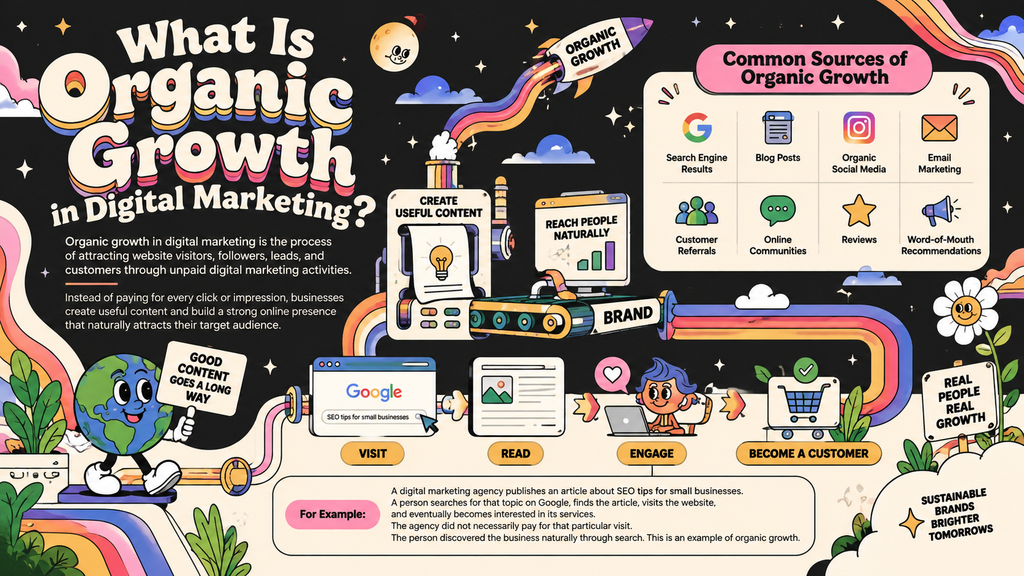
Organic growth in digital marketing is the process of attracting website visitors, followers, leads, and customers through unpaid digital marketing activities.
Instead of paying for every click or impression, businesses create useful content and build a strong online presence that naturally attracts their target audience.
Common sources of organic growth include:
- Search engine results
- Blog posts
- Organic social media
- Email marketing
- Customer referrals
- Online communities
- Reviews
- Word-of-mouth recommendations
For example, imagine a digital marketing agency publishes an article about SEO tips for small businesses. A person searches for that topic on Google, finds the article, visits the agency’s website, and eventually becomes interested in its services.
The agency did not necessarily pay for that particular visit. As a result, the visitor discovered the business naturally through search. This is an example of organic growth.
How Does Organic Growth Work?
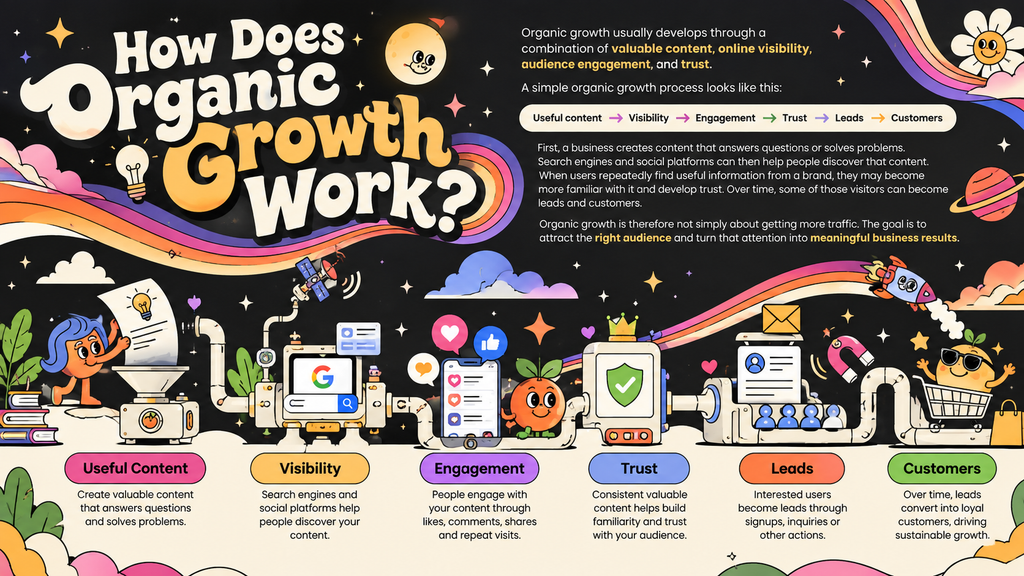
Organic growth usually develops through a combination of valuable content, online visibility, audience engagement, and trust.
A simple organic growth process looks like this:
Useful content → Visibility → Engagement → Trust → Leads → Customers
First, a business creates content that answers questions or solves problems. As a result, search engines and social platforms can help people discover that content.
As a result, when users repeatedly find useful information from a brand, they may become more familiar with it and develop trust. Eventually, some of those visitors can become leads and customers.
Organic growth is therefore not simply about getting more traffic. The goal is to attract the right audience and turn that attention into meaningful business results.
Organic Growth vs Paid Growth
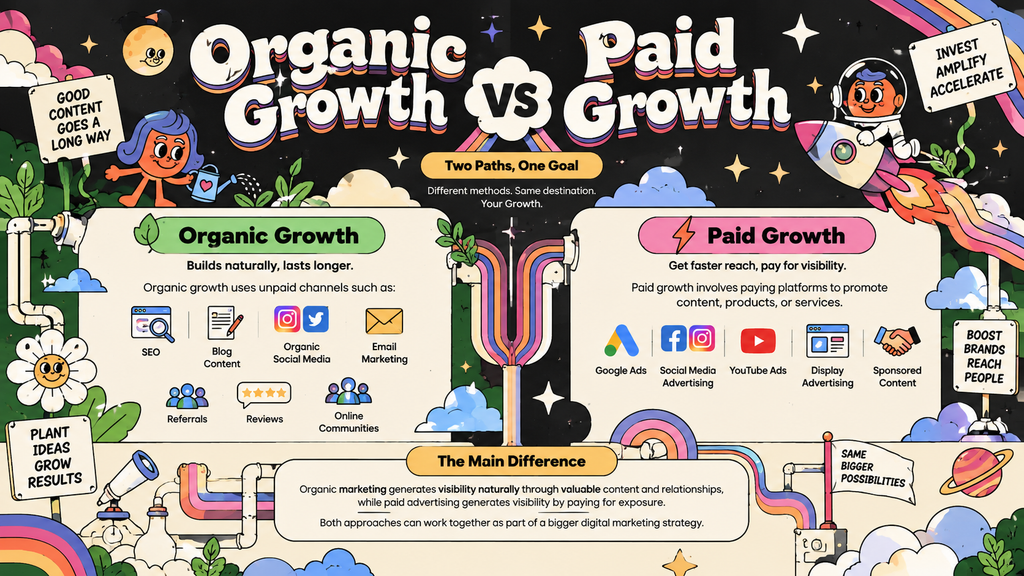
Organic and paid marketing use different methods to attract an audience.
Organic Growth
Organic growth uses unpaid channels such as:
- SEO
- Blog content
- Organic social media
- Email marketing
- Referrals
- Reviews
- Online communities
Paid Growth
Paid growth involves paying platforms to promote content, products, or services.
Examples include:
- Google Ads
- Social media advertising
- YouTube Ads
- Display advertising
- Sponsored content
The main difference is how visibility is generated. With paid advertising, businesses pay for exposure. In contrast, organic marketing requires businesses to invest time and resources into creating valuable content and building relationships that can generate visibility naturally.
Additionally, businesses can combine both approaches as part of a broader digital marketing strategy..
Why Is Organic Growth Important?
Organic growth can help businesses establish a sustainable online presence and reduce their dependence on paid advertising.
1. Builds Long-Term Visibility
For instance, a well-optimized blog post can potentially appear in search results for a long period if it continues to provide relevant and useful information.
2. Builds Trust and Credibility
People often research a business before making a purchase. For this reason, educational content can demonstrate knowledge and help potential customers understand their problems and possible solutions.
Rather than constantly telling customers that a brand is trustworthy, useful content gives them an opportunity to experience the brand’s expertise.
3. Reduces Dependence on Advertising
Paid advertising requires an ongoing budget. When a campaign stops, the paid traffic generated by that campaign can also stop.
Organic content can continue providing value after publication. However, organic marketing is not completely free because it requires time, skills, tools, and resources.
4. Attracts Relevant Visitors
Organic search often starts with a specific question or problem.
For example, someone searching for “how to improve website SEO” already has an interest in SEO. Creating useful content around relevant searches can help businesses reach people who are genuinely interested in their products or services.
5. Strengthens Brand Awareness
Furthermore, consistent content across search engines, social media, websites, and other channels can help people become familiar with a brand.
Repeated exposure to useful information can gradually strengthen brand recognition.
Effective Organic Growth Strategies in Digital Marketing
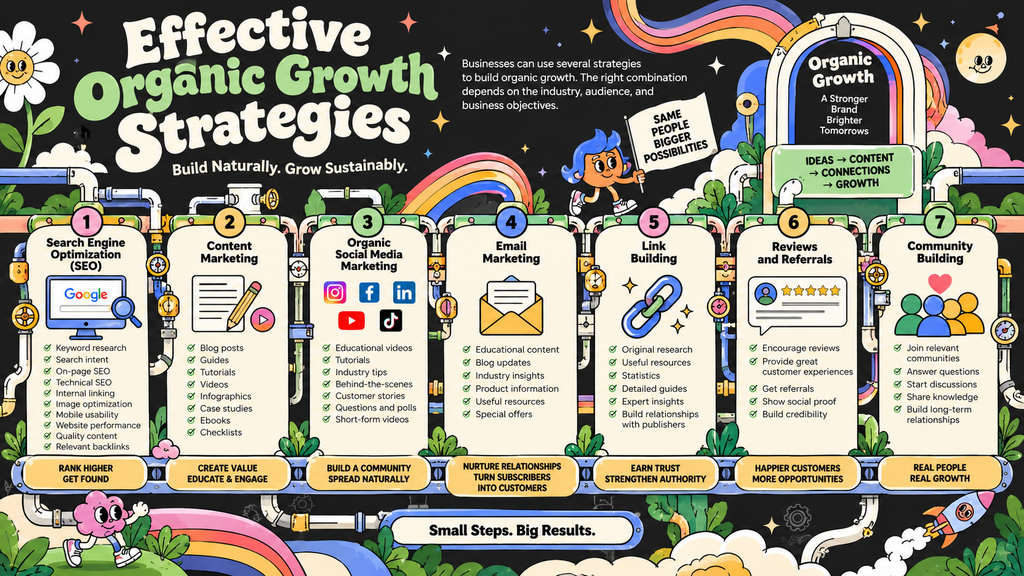
Businesses can use several strategies to build organic growth. The right combination depends on the industry, audience, and business objectives.
1. Search Engine Optimization
First, SEO is one of the most important organic growth strategies.
In practice, search engine optimization involves improving a website and its content so search engines can better understand and display relevant pages to users.
Important areas of SEO include:
- Keyword research
- Search intent
- On-page SEO
- Technical SEO
- Internal linking
- Image optimization
- Mobile usability
- Website performance
- Quality content
- Relevant backlinks
For example, a travel website could create a detailed article about best places to visit in Himachal Pradesh. If the article provides useful information and satisfies search intent, it may attract organic search traffic.
2. Content Marketing
Content marketing involves creating useful information for a specific audience.
Content can include:
- Blog posts
- Guides
- Tutorials
- Videos
- Infographics
- Case studies
- Ebooks
- Checklists
Good content should solve a problem, answer a question, or provide useful information.
Instead of publishing an article simply because a keyword has search volume, ask:
Does this content genuinely help the person searching for it?
3. Organic Social Media Marketing
Social media can help businesses build an audience without paying for every piece of exposure.
Platforms such as Instagram, LinkedIn, YouTube, Facebook, and TikTok can be used to share useful and engaging content.
Examples include:
- Educational videos
- Tutorials
- Industry tips
- Behind-the-scenes content
- Customer stories
- Questions and polls
- Short-form videos
However, consistency is important, and businesses should focus on content quality and audience relevance rather than simply posting as frequently as possible.
4. Email Marketing
Email marketing helps businesses build direct relationships with people who have chosen to receive their communications.
Businesses can use newsletters to share:
- Educational content
- Blog updates
- Industry insights
- Product information
- Useful resources
- Special offers
Therefore, the objective should be to provide value instead of sending constant promotional messages.
5. Link Building
Backlinks are links from other websites to your website. Moreover, these relevant and trustworthy links can help search engines discover pages and can contribute to a website’s authority.
To earn these links, businesses can focus on:
- Publishing original research
- Creating useful resources
- Producing statistics
- Writing detailed guides
- Providing expert insights
- Building relationships with relevant publishers
The goal should be to earn relevant, useful links rather than simply collecting as many links as possible.
6. Reviews and Referrals
Satisfied customers can become an important source of organic growth.
Additionally, a positive customer experience may encourage people to recommend a business to friends, colleagues, or online communities.
Businesses can also make it easier for genuine customers to leave reviews on appropriate platforms. In addition, authentic reviews can provide social proof and help potential customers understand other people’s experiences.
7. Community Building
Building a community around a brand can create stronger long-term relationships.
For example, businesses can participate in relevant online communities, answer questions, start useful discussions, and share knowledge.
The key is to contribute genuinely instead of treating every interaction as an advertisement.
How to Build an Organic Growth Strategy
A successful strategy should be planned rather than based on random content.
Step 1: Understand Your Audience
Identify your target audience and understand their problems, questions, interests, needs, and online behavior.
Step 2: Set Clear Goals
Decide what you want organic growth to achieve.
Your goals might include increasing organic traffic, generating leads, improving brand awareness, growing an email list, or increasing conversions.
Step 3: Research Keywords
First, find search terms and topics that are relevant to your audience. However, don’t focus only on search volume. Instead, consider search intent and whether the topic is useful for your business.
Step 4: Create Useful Content
Next, develop content that answers specific questions and provides genuine value. Then, use clear headings, short paragraphs, examples, and relevant visuals.
Step 5: Optimize Your Website
In addition, make sure your website is easy to navigate and works well on different devices.
Pay attention to:
- Page speed
- Mobile usability
- Internal links
- Website structure
- Metadata
- Image optimization
- Readability
- Security
Step 6: Promote Your Content
Share useful content through relevant social media platforms, email newsletters, communities, and industry relationships.
Step 7: Measure and Improve
Finally, track metrics such as organic traffic, impressions, clicks, engagement, leads, and conversions. Then, use these insights to improve future content and marketing activities.
How Long Does Organic Growth Take?
Organic growth does not have a fixed timeline.
For example, a new website may need significant time to establish visibility, while an established website with existing authority may see results sooner.
Factors that influence organic growth include:
- Industry competition
- Website history
- Content quality
- SEO implementation
- Keyword difficulty
- Search intent
- Publishing consistency
- Backlink profile
This is why organic marketing should generally be treated as a long-term strategy rather than a quick shortcut.
Common Organic Growth Mistakes
Publishing Without Research
Creating content without understanding your audience can result in articles that receive little attention.
Keyword Stuffing
Repeating keywords excessively can make content unnatural and difficult to read. Keywords should be used naturally.
Being Inconsistent
Publishing frequently for a short period and then stopping can make it difficult to build a sustainable content system.
Ignoring Existing Content
Furthermore, older articles can often be improved with updated information, better formatting, additional internal links, and clearer answers.
Focusing Only on Traffic
More visitors do not automatically mean more customers. Businesses should also consider whether their traffic is relevant and whether visitors take meaningful actions.
Best Practices for Sustainable Organic Growth in Digital Marketing
To build sustainable organic growth, focus on these principles:
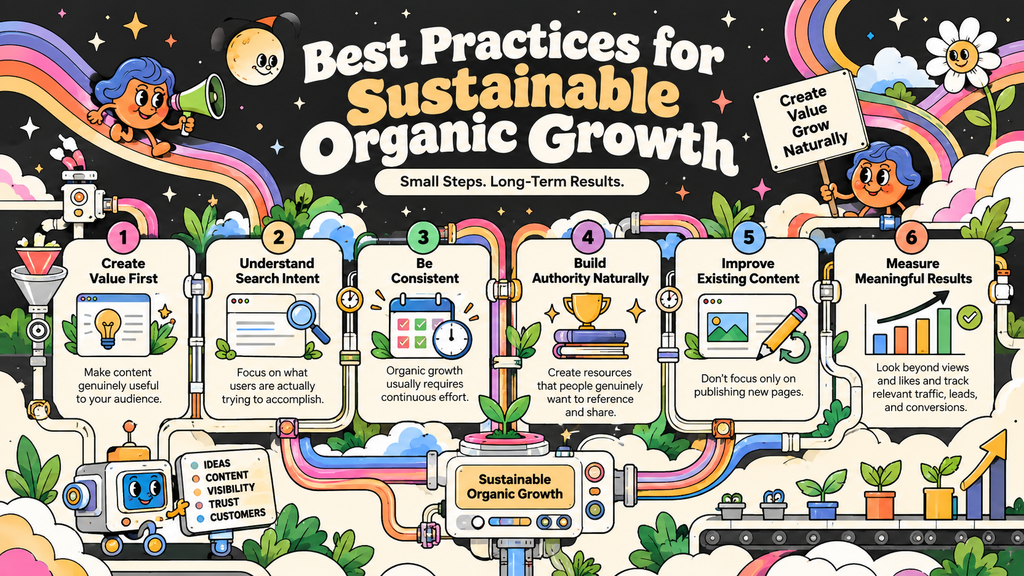
Create value first: Make content genuinely useful to your audience.
Understand search intent: Focus on what users are actually trying to accomplish.
Be consistent: Organic growth usually requires continuous effort.
Build authority naturally: Create resources that people genuinely want to reference and share.
Improve existing content: Don’t focus only on publishing new pages.
Measure meaningful results: Look beyond views and likes and track relevant traffic, leads, and conversions.
Conclusion
Organic growth in digital marketing is about building an online presence that attracts people naturally through value, visibility, and trust.
SEO, content marketing, social media, email marketing, link building, reviews, referrals, and community building can all contribute to an effective organic growth strategy.
The most important thing to remember is that organic growth is not an overnight solution. It is a continuous process of understanding your audience, creating useful content, improving your website, and building trust.
Instead of asking only, “How can I get more traffic?”, businesses should also ask:
“How can I provide enough value that the right people want to find, trust, and return to my brand?”
That mindset is at the heart of sustainable organic growth.
Pingback: SEO Isn’t Dead — You’re Just Doing It Wrong - itsumar.com