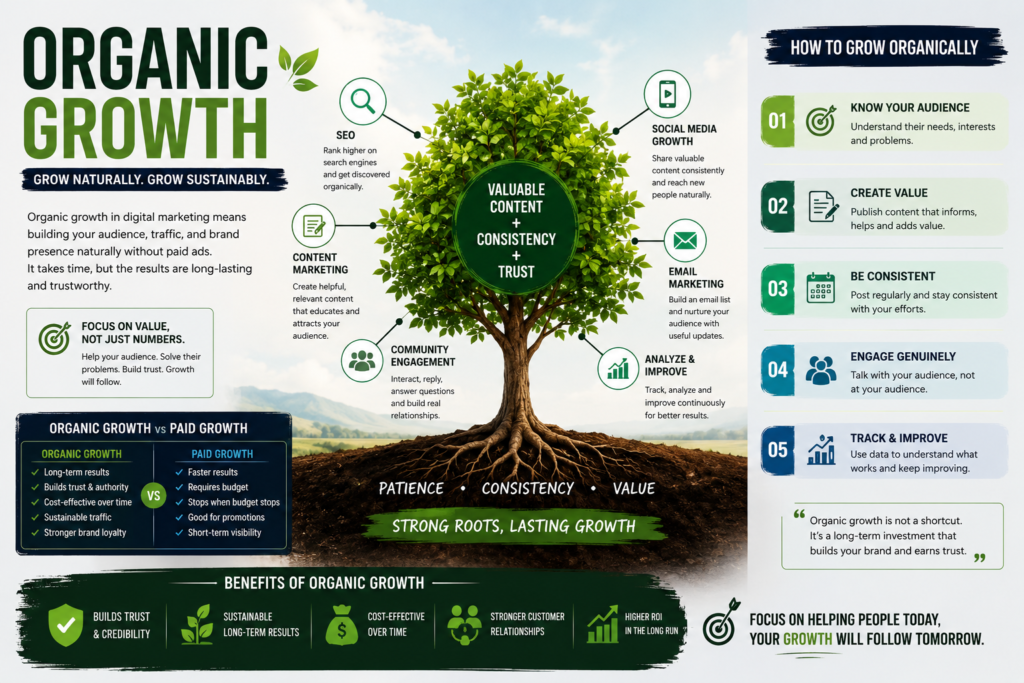
In digital marketing, businesses often face an important question: Should we pay for advertising or focus on organic growth?
Paid marketing can bring quick visibility, but organic marketing focuses on building an audience naturally through valuable content, search engines, social media, and genuine relationships. It may take more time, but a strong organic presence can create long-term results and brand trust.
For startups, small businesses, creators, and beginners, understanding organic growth is one of the most important parts of building a successful digital presence.
What Is Organic Growth?
Organic growth means increasing your website visitors, social media followers, engagement, leads, or customers without directly paying for each individual result through advertising.
For example, if someone searches Google for “digital marketing tips for beginners” and discovers your blog through the search results, that visitor is an example of organic traffic.
Similarly, if someone discovers your Instagram account because a Reel was recommended to them and then follows your page, that can be considered organic social media growth.
Organic growth is primarily driven by valuable content, SEO, consistency, engagement, and audience trust.
Why Is Organic Growth Important?
One of the biggest advantages of organic marketing is that it can continue generating results after the initial work has been completed.
Imagine writing a useful blog post today. If that article ranks well on Google, it could potentially bring visitors to your website for months or even years.
The same principle applies to social media. A high-quality Reel, YouTube video, or educational post can continue reaching new people after it has been published.
Organic growth also helps businesses build credibility. People are more likely to trust a brand when they repeatedly see useful information from it instead of seeing only advertisements.
1. SEO: The Foundation of Organic Website Growth
Search Engine Optimization, or SEO, is one of the most important organic growth strategies.
SEO involves improving your website and content so search engines can understand it and show it to people searching for relevant information.
A basic SEO strategy includes:
- Finding relevant keywords
- Creating useful and original content
- Writing descriptive titles
- Optimizing headings
- Improving website speed
- Using internal links
- Making content mobile-friendly
- Building website authority
For example, if you run a digital marketing website, instead of creating a generic article titled “Marketing,” you could create targeted content such as “Digital Marketing Trends 2026” or “SEO for Beginners: A Simple Guide.”
Specific topics are often easier to target and provide clearer value to readers.
2. Content Marketing Builds Long-Term Visibility
Content is at the heart of organic growth.
Businesses can create blogs, videos, social media posts, guides, newsletters, podcasts, case studies, and infographics.
The goal isn’t simply to publish content every day. The goal is to create content that answers questions and solves problems.
A simple content strategy can follow the 80/20 principle: focus primarily on providing value, education, entertainment, or inspiration, while keeping direct promotion limited.
Ask yourself before publishing:
“Will my audience find this useful?”
If the answer is yes, you’re moving in the right direction.
3. Social Media and Community Building
Social media can be a powerful source of organic growth when used consistently.
Instead of focusing only on follower numbers, businesses should focus on creating meaningful interactions.
Reply to comments, answer questions, participate in conversations, and understand what your audience wants to see.
Short-form videos are particularly useful for organic discovery because platforms such as Instagram, YouTube, and TikTok can recommend content beyond a creator’s existing followers.
However, viral content shouldn’t be the only goal. A smaller audience that genuinely trusts your brand can be more valuable than thousands of inactive followers.
4. Consistency Matters More Than Perfection
One of the biggest mistakes beginners make is expecting immediate results.
Organic growth usually takes time.
A website may take months to build search visibility. A social media account may require dozens of posts before understanding what works. A YouTube channel may need consistent uploads before gaining momentum.
Instead of trying to become successful overnight, focus on creating a sustainable publishing routine.
For example:
- 2–3 social media posts per week
- 2 short-form videos per week
- 1 useful blog article per week
- Regular engagement with your audience
The exact schedule isn’t as important as maintaining quality and consistency.
5. Build an Email Audience
Social media platforms can change their algorithms at any time. Your reach can increase or decrease without warning.
An email list gives you a more direct relationship with your audience.
You can encourage website visitors to subscribe by offering useful resources such as guides, checklists, newsletters, templates, or exclusive content.
Once someone subscribes, you can provide valuable information through regular emails and gradually build trust with them.
Organic Growth vs Paid Growth
| Organic Growth | Paid Growth |
|---|---|
| Usually takes more time | Can produce faster results |
| Focuses on long-term visibility | Focuses on immediate reach |
| Builds trust and authority | Provides targeted exposure |
| SEO and content are important | Advertising budget is required |
| Results can continue over time | Results often depend on continued spending |
| Good for long-term brand building | Good for campaigns and quick traffic |
The two approaches don’t have to compete with each other. In fact, many successful businesses use both.
Organic marketing can build long-term authority, while paid marketing can help promote important products, launches, or campaigns.
Common Organic Growth Mistakes
Many businesses struggle with organic growth because they focus on the wrong metrics.
Some common mistakes include:
Chasing followers instead of building relationships: A large follower count doesn’t automatically mean a successful business.
Posting without a strategy: Random content makes it difficult to build a recognizable brand.
Ignoring SEO: Creating great content doesn’t help much if your audience cannot discover it.
Expecting instant results: Organic growth requires patience and continuous improvement.
Copying competitors: Inspiration is useful, but original ideas and unique perspectives help a brand stand out.
How to Build an Organic Growth Strategy
A simple organic growth strategy can follow five steps:
1. Define your audience
Understand who you want to reach and what problems they have.
2. Choose your platforms
Focus on the platforms where your audience is actually active.
3. Create valuable content
Educate, entertain, inspire, or solve problems.
4. Stay consistent
Create a realistic publishing schedule and follow it.
5. Measure and improve
Track traffic, engagement, conversions, search rankings, and other meaningful metrics.
Final Thoughts
Organic growth isn’t about finding a secret hack that suddenly makes your business successful. It is about consistently providing value and building trust with your audience.
SEO can bring people to your website. Content can educate them. Social media can create conversations. Email can build relationships. Over time, these activities can work together to create a strong digital presence.
Paid advertising can buy attention, but organic marketing can help you earn it.
For businesses and creators looking to build something sustainable, organic growth should be viewed as a long-term investment rather than a quick shortcut.