Digital marketing is changing faster than ever. From artificial intelligence and short-form videos to social commerce and personalized advertising, businesses are finding new ways to reach customers online. In 2026, simply having a website or social media page is no longer enough. Brands need to understand how people search, watch, interact, and make purchasing decisions online.
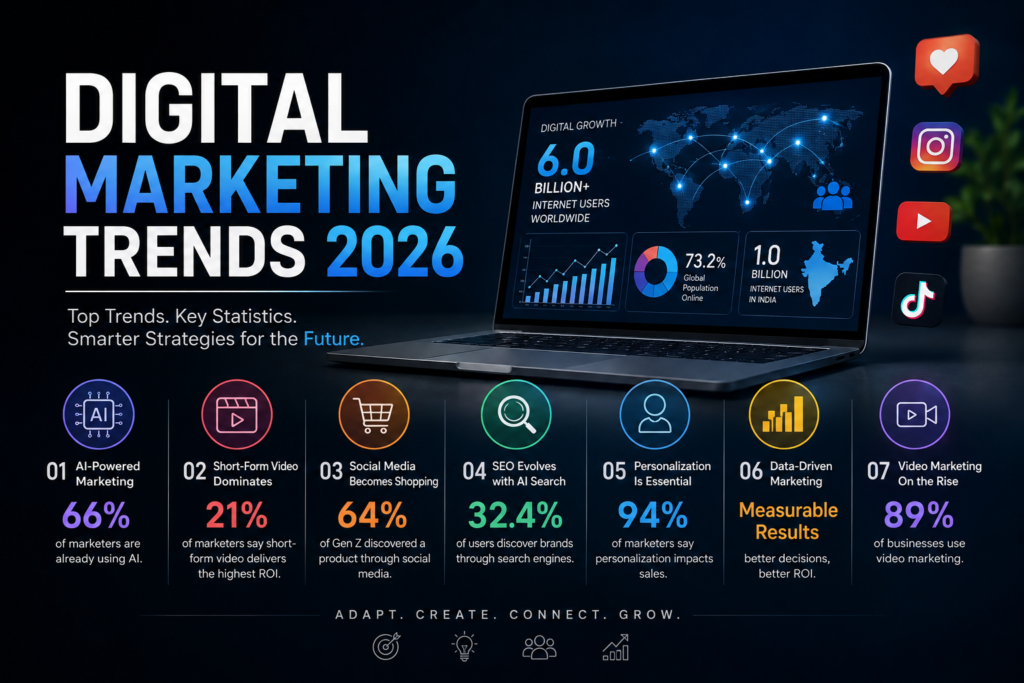
The scale of the digital world explains why digital marketing has become so important. According to DataReportal’s Digital 2026 report, more than 6 billion people worldwide use the internet, representing around 73.2% of the global population. India alone has around 1 billion internet users, making it one of the most important markets for digital businesses.
Here are some of the biggest digital marketing trends shaping 2026.
1. Artificial Intelligence Is Transforming Marketing
Artificial intelligence (AI) has moved from being an experimental technology to becoming an everyday marketing tool. Marketers are using AI to generate content ideas, write drafts, analyze data, create images and videos, personalize campaigns, and automate repetitive tasks.
HubSpot’s research found that 66% of marketers globally were already using AI in their roles. Another HubSpot study found that content creation was one of the most common AI applications among marketers.
However, AI does not mean that human creativity is becoming irrelevant. Instead, successful marketers are using AI as an assistant while keeping human creativity, strategy, storytelling, and fact-checking at the center of their campaigns.
2. Short-Form Video Continues to Dominate
Short-form video has become one of the most powerful content formats in digital marketing. Instagram Reels, YouTube Shorts, and TikTok have changed how people consume information online.
HubSpot’s marketing research found that short-form video was the highest-ROI content format, with 21% of marketers identifying it as the format delivering the highest return in its 2025 survey. More recent HubSpot reporting shows short-form video continuing to lead content strategies going into 2026.
For businesses, this means that a 20–40 second video explaining a product, answering a question, showing behind-the-scenes content, or telling a story can sometimes attract more attention than a long advertisement.
The key is not simply creating more videos. Brands need to create videos that are useful, entertaining, authentic, and easy to understand.
3. Social Media Is Becoming a Shopping Platform
Social media is no longer only about likes, comments, and followers. Platforms are increasingly becoming part of the complete customer journey — from discovering a product to researching it and eventually purchasing it.
HubSpot found that 64% of Gen Z and 59% of Millennials surveyed had discovered a product through social media in the previous three months. It also found that 17% of social media users had purchased a product directly through an app during that period.
This makes social commerce particularly important for fashion, beauty, food, lifestyle, and e-commerce brands.
Businesses should therefore optimize their social profiles not only for engagement but also for discovery, trust, product information, and conversions.
4. SEO Is Evolving With AI Search
Search engine optimization remains important, but the way people search for information is changing. Users are increasingly asking AI tools questions alongside traditional search engines.
However, traditional search is far from disappearing. DataReportal reports that 32.4% of global internet users aged 16+ say search engines are a source of brand discovery, compared with 30.1% for social media advertisements. Meanwhile, 14.8% say they discover brands through AI tools.
For marketers, the lesson is simple: don’t abandon SEO. Instead, create helpful, original, well-structured content that can be understood by both search engines and AI-powered discovery systems.
5. Personalization Is Becoming Essential
Customers don’t want to feel like they are receiving the same message as everyone else. Personalized emails, recommendations, advertisements, and website experiences can make marketing more relevant.
According to HubSpot’s research, 94% of marketers reported that personalized customer experiences impact their company’s sales.
Businesses can use customer data responsibly to understand interests, previous interactions, purchasing behavior, and preferences. The goal should be to make communication more useful rather than simply collecting more data.
6. Data-Driven Marketing Is More Important Than Ever
Digital marketing provides something traditional marketing often struggles to provide: measurable results.
Marketers can track website visits, engagement, clicks, leads, conversions, customer acquisition costs, and return on advertising spend. These insights allow businesses to identify what is working and change what isn’t.
Instead of asking, “Did our advertisement look good?” marketers can ask more useful questions such as, “How many people clicked?”, “How many became customers?”, and “What was our return on investment?”
7. Video Marketing Is Becoming More Accessible
Video marketing used to require expensive cameras, editing software, and production teams. Today, smartphones and AI-powered editing tools have dramatically lowered the barrier to entry.
HubSpot’s video marketing research reported that 89% of businesses use video marketing, while 93% of marketers consider video an important part of their overall strategy.
This creates an opportunity for small businesses and personal brands. A smartphone, good lighting, clear audio, and a strong idea can be enough to begin.
The Future of Digital Marketing
The future of digital marketing is not about choosing one platform or one technology. It is about combining different channels into a connected customer experience.
AI can help marketers work faster. SEO can help people discover a brand. Social media can build relationships. Short-form video can capture attention. Personalization can improve the customer experience. Analytics can show whether the strategy is actually working.
The biggest advantage will belong to businesses that can combine technology with human creativity.
Conclusion
Digital marketing in 2026 is becoming more intelligent, visual, personalized, and data-driven. With more than 6 billion people online globally, the digital audience is enormous, but competition for attention is also increasing.
For businesses and aspiring digital marketers, the best approach is to focus on the fundamentals: understand your audience, create valuable content, build trust, measure results, and continuously adapt to new technologies.
The platforms will change. Algorithms will change. AI tools will change. But the core principle of digital marketing will remain the same: reach the right people with the right message at the right time.
Statistics and industry figures referenced in this article are based on recent reports from DataReportal and HubSpot and may change as new research becomes available.